SHORT COURSE | Netherlandish Painting and Renaissance Italy | Paula Nuttall
SHORT COURSE | Netherlandish Painting and Renaissance Italy | Paula Nuttall
From our archive: lectures given February - March 2021
Link expires: Wednesday 30 September 2026
Please ensure you allow enough time to watch the recordings before the link expires.
It is now recognised that early Netherlandish painting was not only widely admired in Renaissance Italy, but that it had a transformative effect on Italian art itself. Learn about the reception of Netherlandish painting in Italy in this short course of three one-hour lectures with V&A Course Director, Dr Paula Nuttall, an authority on the subject.
Lecture One: Common Ground
Jan van Eyck and Rogier van der Weyden were regarded by 15th-century Italian humanist writers as the greatest painters of their day. The naturalism of their paintings, made possible by their superb command of oils (as yet used to only a limited extent in Italy) chimed with artistic concerns in contemporary Italy, where painters such as Masaccio, Gentile da Fabriano and Fra Angelico were likewise interested in the representation of reality, from the human body to perspectival space and naturalistic light.
In this lecture, works by the first generation of Renaissance artists, north and south, are compared, shedding light on their shared aims and relative achievements, as well as viewing Netherlandish painting through the lens of contemporary Italian commentators.
Lecture Two: Princes, Merchants and Patrons
Netherlandish paintings graced the collections of the Italian elite, from the rulers of Ferrara, Urbino and Naples to the patricians of Venice and Genoa, and the Medici in Florence. While some exchanged hands as diplomatic gifts, many reached Italy through the agency of the long-established Italian mercantile colony in the international city of Bruges. Here Italians were themselves discerning patrons of local artists, notably Van Eyck’s patron Giovanni Arnolfini of Lucca, and Tommaso Portinari, manager of the Bruges branch of the Medici bank and commissioner of the great triptych by Hugo van der Goes now in the Uffizi.
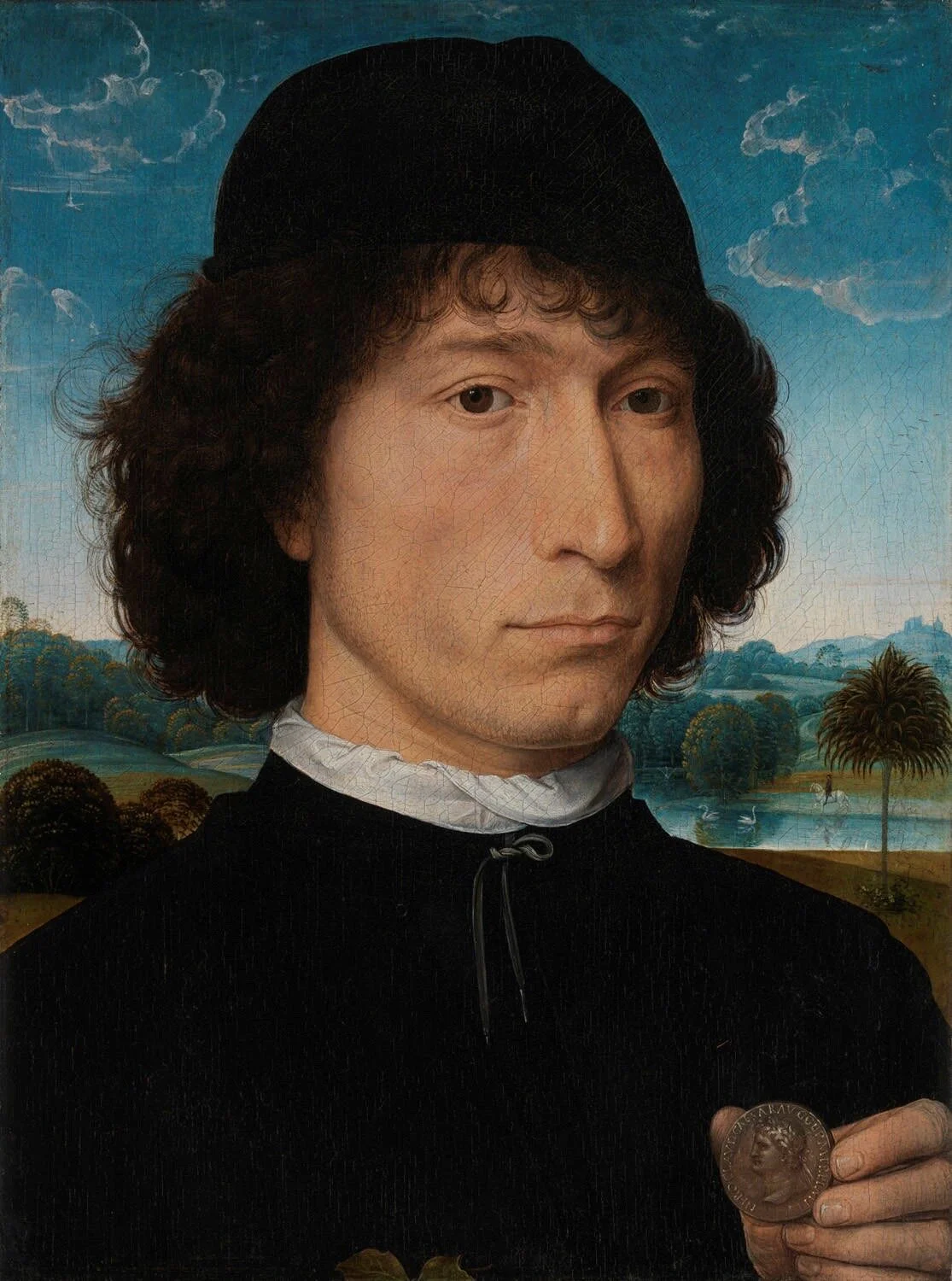
At the end of the century, Hans Memling was virtually the unofficial painter to the expatriate community, particularly sought after for his portraits and small devotional images. Working in this international ambit, Memling was also among the first Netherlandish painters to respond to contemporary Italian art.
Lecture Three: Artistic Responses
Increasing familiarity with Netherlandish paintings from about 1470, brought about by the travels of artworks and artists, resulted in a wide range of responses from Italian painters, affecting almost every aspect of their artistic production, from the gradual assimilation of the oil technique, to the appropriation of Netherlandish landscape forms and portrait types, and the use of novel Netherlandish devotional and secular imagery, including the erotic female nude.
In this last lecture we consider these diverse responses, looking at artists such as Piero della Francesca, Antonello da Messina, Giovanni Bellini, Domenico Ghirlandaio and Leonardo da Vinci. By 1500 the lessons learnt from Netherlandish painting had been absorbed into the Italian visual language, as exemplified in the art of the young Raphael, and Michelangelo himself.